Managing Restrictions
This guide provides step-by-step instructions for creating, viewing, editing, and deleting restrictions using the GetApp Dashboard.
Prerequisites
Before managing restrictions, ensure you have:
- Access to the GetApp Dashboard
- Appropriate user permissions (Restriction management roles)
- At least one registered device or device type
Accessing Restriction Management
Restrictions and policies are managed together on the same page.
Navigation Path
- Log in to the GetApp Dashboard
- Navigate to Rules in the main menu
- Both restrictions and policies are displayed in the same list
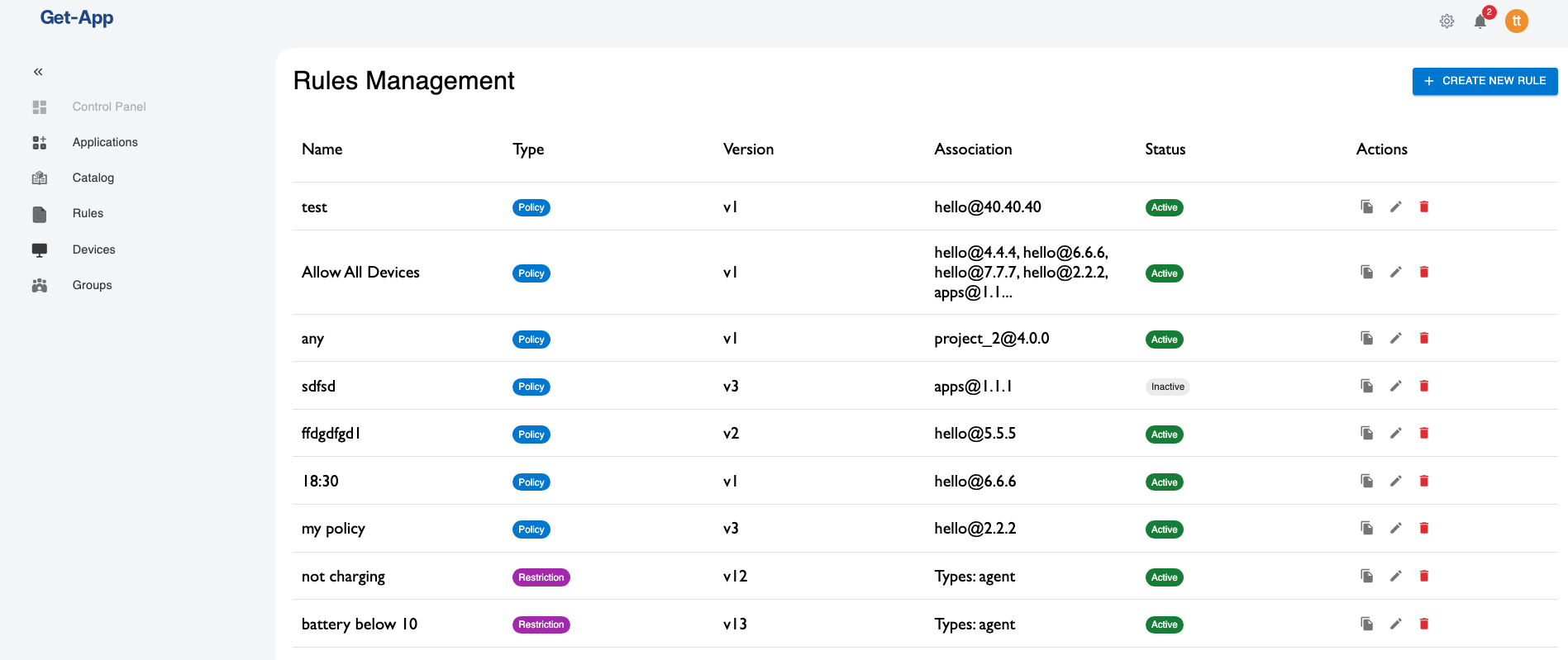
Note: The Rules page displays both restrictions and policies together.
Viewing Restrictions
Restrictions List View
The restrictions list displays all defined restrictions in your system.
Information Displayed:
- Name: Restriction identifier
- Type: "Restriction"
- Version: Current version number
- Association: What the restriction applies to (devices, device types, OS types)
- Status: Active or Inactive
- Actions: Edit, Delete, Duplicate, View buttons
Viewing Restriction Details
To view detailed information about a restriction:
- Click on the restriction name in the list
- A details panel opens showing:
- Full restriction name
- Description
- Type (Restriction)
- Version number
- Creation date
- Last modified date
- Active/Inactive status
- Associations (device IDs, device types, OS types)
- Complete rule definition
- List of affected devices
Understanding What Gets Blocked
The restriction details show:
- Rule Expression: What conditions trigger the block
- Effect: What gets blocked when the rule matches
- Affected Devices: Which devices have this restriction
- Evaluation Count: How many times it has been evaluated (if tracked)
Creating a New Restriction
Opening the Create Dialog
- Navigate to the Rules page
- Click the Create or Add Rule button
- A popup dialog opens with a 3-step wizard
Step 1: Basic Information
In the first step, configure the basic restriction details:
Name (Required):
- Enter a descriptive name
- Must be unique within your restrictions
- Examples: "Block Dev Software on Production", "Prevent GPU Apps on Basic Workstations"
Description (Optional):
- Add a detailed explanation
- Explain what is blocked and why
- Document any special considerations
Type (Required):
- Select Restriction from the dropdown
- (Policy is the other option)
Status (Required):
- Active: Restriction takes effect immediately and syncs to devices
- Inactive: Restriction is created but not enforced (for testing or future use)
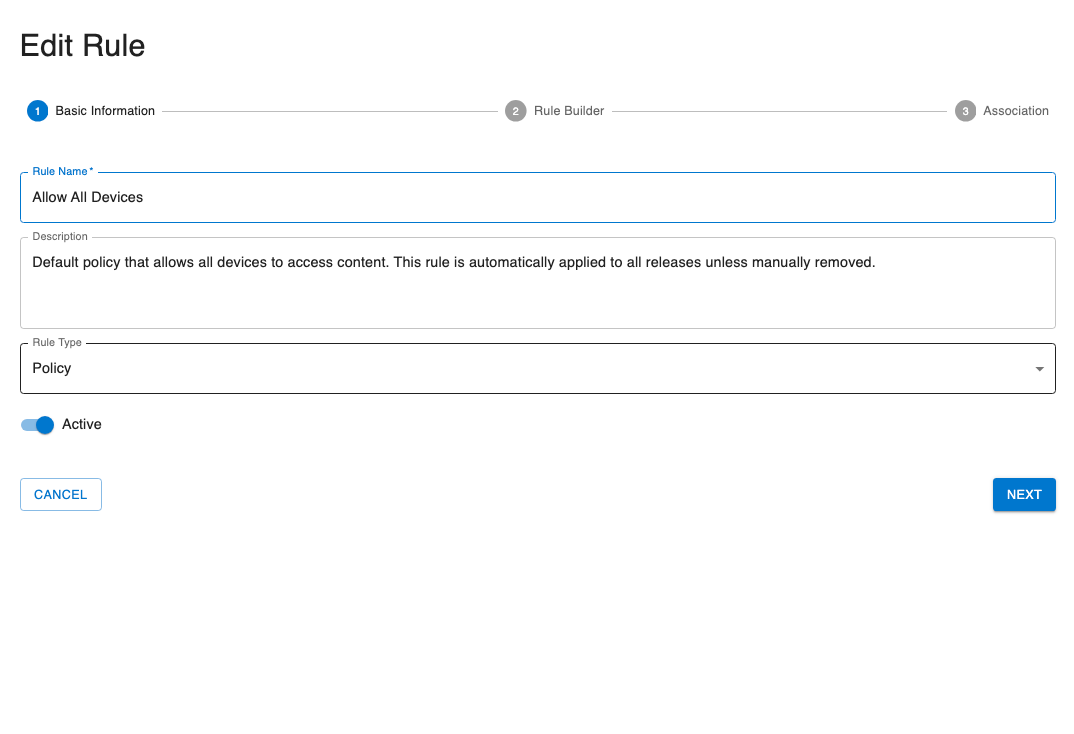
Click Next to proceed to step 2.
Step 2: Build the Rule
In the third and final step, select what this restriction applies to. You can choose one or more association types:
Associate with Specific Devices
To apply this restriction to individual devices:
- Click Add Devices or select Device tab
- Search for devices by name or ID
- Select devices from the list
- Click Add
- Selected devices appear in the association list
Use When: Targeting specific critical devices with unique requirements.
Associate with Device Types
To apply this restriction to all devices of certain types:
- Click Add Device Types or select Device Type tab
- Select one or more device types from the dropdown
- Click Add
- Selected device types appear in the association list
Use When: Applying hardware-specific restrictions to entire classes of devices.
Example: All "LegacyServer" devices should have certain restrictions.
Associate with OS Types
To apply this restriction to all devices with certain operating systems:
- Click Add OS Types or select OS Type tab
- Select one or more OS types from the dropdown
- Options typically include: Linux, Windows, MacOS, etc.
- Click Add
- Selected OS types appear in the association list
Use When: Applying OS-specific compatibility restrictions.
Example: Block certain software on all Linux devices.
Combined Associations
You can combine multiple association types:
- Add device IDs AND device types AND OS types
- The restriction applies to devices matching ANY of the associations (OR logic)
Example: Apply to device-12345 OR all ProductionServers OR all Linux devices.
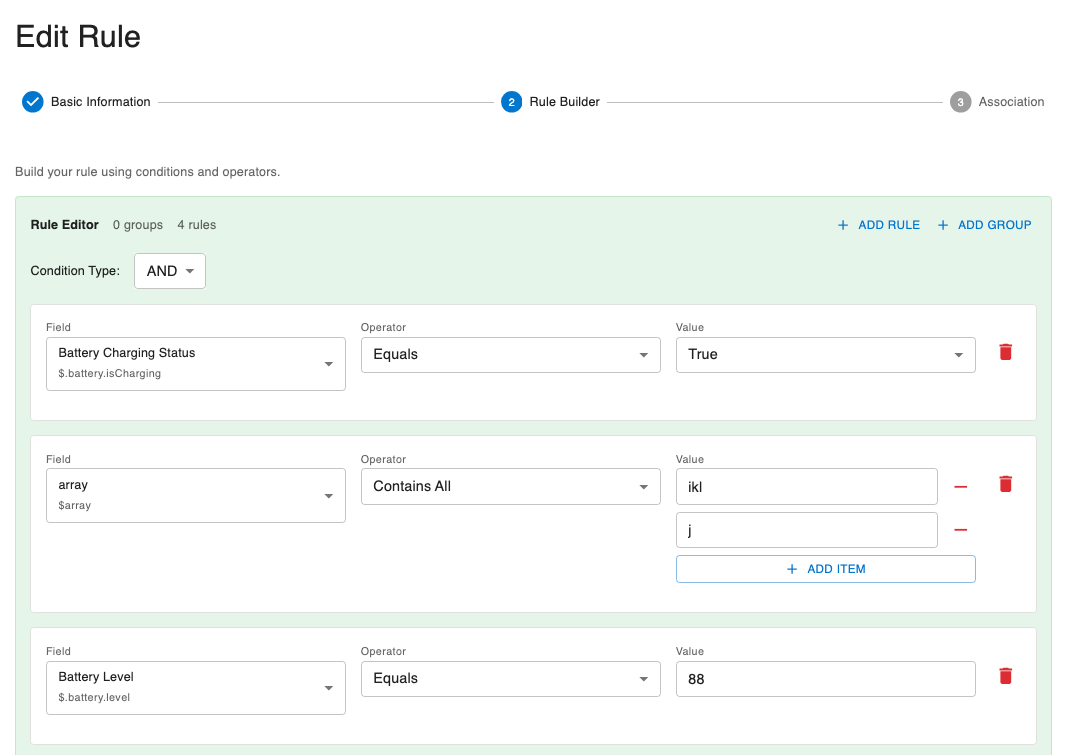
In the second step, create the rule expression that defines what gets blocked.
The rule builder provides:
- Visual Rule Builder: A graphical interface for building rules
- JSON Preview: Real-time JSON representation of your rule
Understanding Blocking Logic
When the rule evaluates to true, the installation is blocked.
Example: If rule is projectName equals "BlockedApp", then installations of BlockedApp are prevented.
Simple Rule
For a simple blocking condition:
- Select Simple Rule option
- Choose a Field from the dropdown
- Common fields: projectName, version, environment, requiresGPU, etc.
- Choose an Operator
- Common operators: equals, not-equls, contains, less-than, greater-than
- Enter the Value
- The value to compare against
- See the JSON preview update automatically
Example: Block project "UnsafeApp"
- Field:
projectName - Operator:
equals - Value:
UnsafeApp
Complex Rule with AND
To block when multiple conditions are ALL true:
- Select Complex Rule option
- Choose AND operator
- Click Add Condition
- For each condition:
- Select field
- Select operator
- Enter value
- Add more conditions as needed
Example: Block "MyApp" versions older than 2.0.0
- Condition 1:
projectName equals "MyApp" - Condition 2:
version less-than "2.0.0"
Complex Rule with OR
To block when ANY of multiple conditions is true:
- Select Complex Rule option
- Choose OR operator
- Click Add Condition
- For each condition:
- Select field
- Select operator
- Enter value
- Add more conditions as needed
Example: Block multiple problematic projects
- Condition 1:
projectName equals "BadApp1" - Condition 2:
projectName equals "BadApp2" - Condition 3:
projectName equals "BadApp3"
Nested Conditions
For advanced blocking logic:
- Start with an outer operator (AND or OR)
- Add conditions
- For nested logic, click Add Group
- Within the group, select operator (AND or OR)
- Add conditions to the nested group
Example: Block BadApp1, BadApp2, or ConditionalApp in production
- Outer: OR
projectName equals "BadApp1"projectName equals "BadApp2"- Inner: AND
projectName equals "ConditionalApp"environment equals "production"
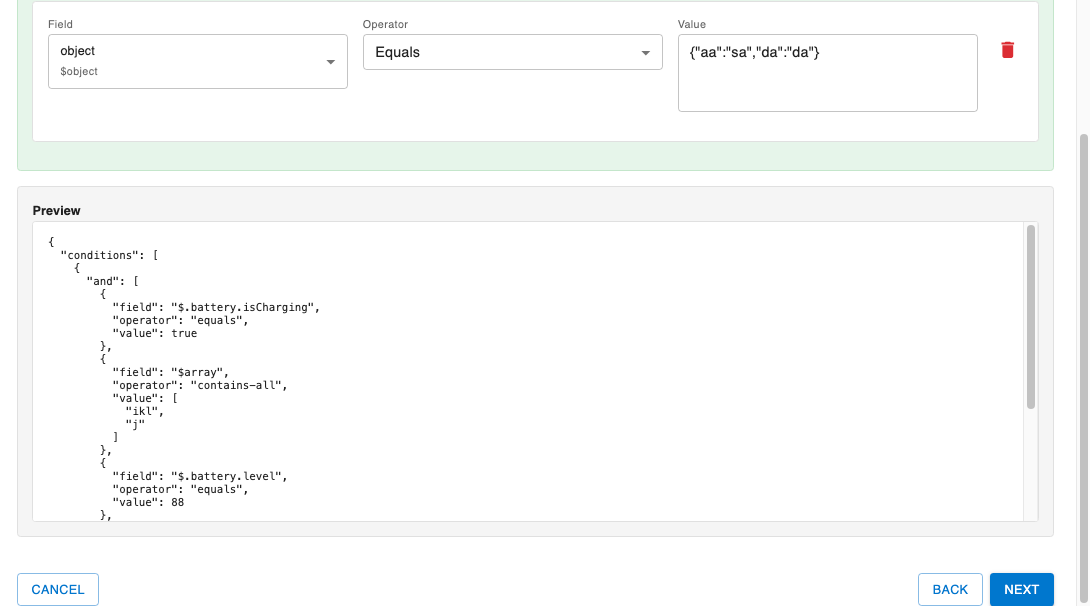
Click Next to proceed to step 3.
Step 3: Define Associations
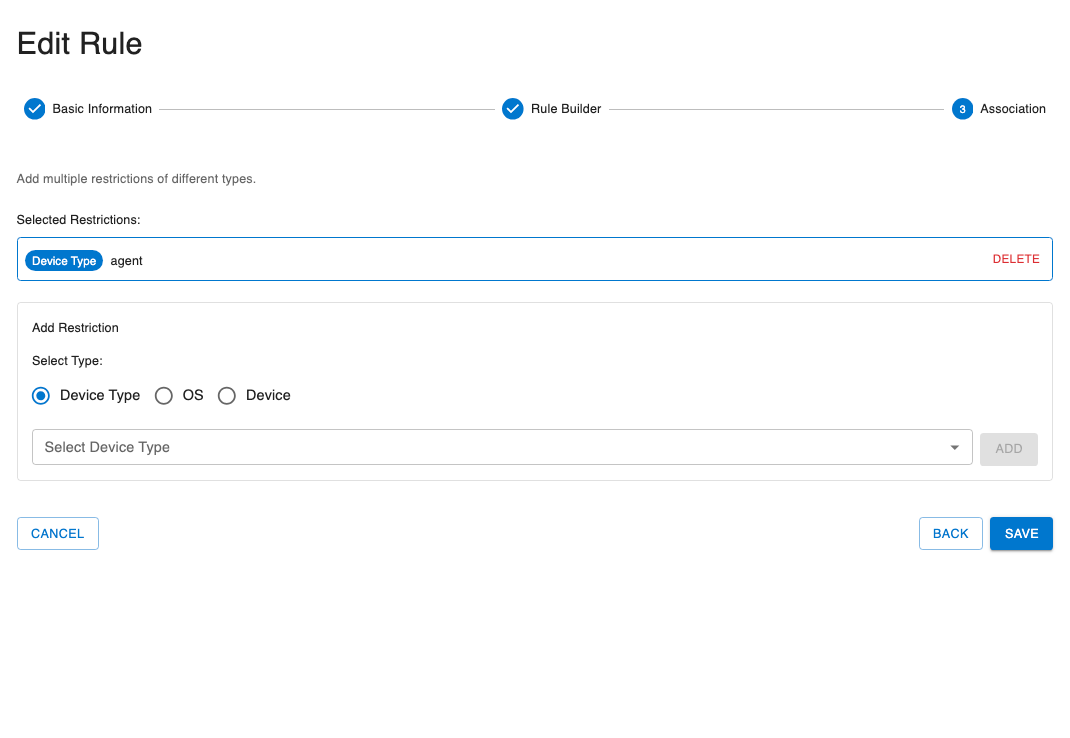
In the third and final step, select what this restriction applies to. You can choose one or more association types:
Associate with Specific Devices
To apply this restriction to individual devices:
- Click Add Devices or select Device tab
- Search for devices by name or ID
- Select devices from the list
- Click Add
- Selected devices appear in the association list
Use When: Targeting specific critical devices with unique requirements.
Associate with Device Types
To apply this restriction to all devices of certain types:
- Click Add Device Types or select Device Type tab
- Select one or more device types from the dropdown
- Click Add
- Selected device types appear in the association list
Use When: Applying hardware-specific restrictions to entire classes of devices.
Example: All "LegacyServer" devices should have certain restrictions.
Associate with OS Types
To apply this restriction to all devices with certain operating systems:
- Click Add OS Types or select OS Type tab
- Select one or more OS types from the dropdown
- Options typically include: Linux, Windows, MacOS, etc.
- Click Add
- Selected OS types appear in the association list
Use When: Applying OS-specific compatibility restrictions.
Example: Block certain software on all Linux devices.
Combined Associations
You can combine multiple association types:
- Add device IDs AND device types AND OS types
- The restriction applies to devices matching ANY of the associations (OR logic)
Example: Apply to device-12345 OR all ProductionServers OR all Linux devices.
Review and Save
- Review all entered information across all three steps
- You can navigate back to any step to make changes
- Preview the rule JSON one final time
- Click Create or Save
- The popup closes and the new restriction appears in the list
- A confirmation message appears
- If active, it will sync to affected devices
Common Creation Errors
Error: "Restriction name already exists"
- Solution: Choose a unique name
Error: "No associations selected"
- Solution: Associate with at least one device, device type, or OS type
Error: "Invalid rule expression"
- Solution: Check that all fields, operators, and values are properly filled in
Error: "Insufficient permissions"
- Solution: Contact your administrator for restriction creation permissions
Editing an Existing Restriction
Step 1: Open Edit Dialog
- Locate the restriction in the restrictions list
- Click the Edit button (pencil icon)
- The Edit Restriction dialog opens with current values populated
Step 2: Modify Restriction Details
You can modify:
- Name: Change the restriction name
- Description: Update the description
- Associations: Add or remove devices, device types, or OS types
- Rule Expression: Modify the blocking logic
- Status: Activate or deactivate
Note: Changing the rule expression or associations will increment the version number automatically.
Step 3: Update Associations
To modify what the restriction applies to:
Add Associations:
- Click Add Devices / Add Device Types / Add OS Types
- Select additional items
- Click Add
Remove Associations:
- Find the association in the list
- Click the DELETE button next to it
- Confirm removal if prompted
Step 4: Update the Rule
To modify the blocking rule:
Simple Changes:
- Update field, operator, or value
- Changes are previewed in real-time
Add Conditions:
- Click Add Condition to add more blocking criteria
- Select the field, operator, and value
Remove Conditions:
- Click the Trash button next to a condition
Change Logic:
- Switch between AND/OR operators
- Reorganize nested groups
Step 5: Save Changes
- Review all modifications
- Click Update Restriction or Save
- Version number increments automatically (if rule or association changed)
- Confirmation message appears
- Changes sync to affected devices (if restriction is active)
Sync Status
After saving:
- Active restrictions sync to devices during their next synchronization
- Monitor the sync status in the restriction details
- Devices may take a few minutes to receive updates
Activating and Deactivating Restrictions
Activate a Restriction
To make an inactive restriction active:
Method 1: From Details View
- Click on the restriction name to open details
- Toggle the Status switch to Active
- Confirm the action
- Restriction immediately syncs to devices and begins blocking
Method 2: From Edit Dialog
- Click Edit on the restriction
- Check the Active checkbox
- Click Save
Deactivate a Restriction
To temporarily suspend a restriction without deleting it:
Method 1: From Details View
- Click on the restriction name
- Toggle the Status switch to Inactive
- Confirm the action
- Restriction stops blocking and is removed from devices
Method 2: From Edit Dialog
- Click Edit on the restriction
- Uncheck the Active checkbox
- Click Save
When to Deactivate:
- Testing other restrictions
- Allowing updates during maintenance windows
- Troubleshooting issues
- Emergency override situations
Sync After Status Change
When you activate or deactivate a restriction:
- Devices receive the update during next sync (typically within minutes)
- Active restrictions are added to device local storage
- Inactive restrictions are removed from device local storage
Duplicating a Restriction
Duplicating creates a copy of an existing restriction, useful for creating similar restrictions.
Step 1: Duplicate
- Locate the restriction to duplicate
- Click the Duplicate button (copy icon)
- A new restriction is created with:
- Name: "Copy of [Original Name]"
- Same rule expression
- Same associations
- Status: Inactive (by default)
- Version: 1 (new restriction)
Step 2: Modify the Copy
- Edit the duplicated restriction
- Change the name
- Modify the rule or associations as needed
- Activate when ready
Use Cases:
- Creating similar restrictions for different device types
- Testing variations of a restriction
- Applying the same logic to different devices
Deleting a Restriction
Warning: Deleting a restriction is permanent and cannot be undone. The restriction will no longer block installations on associated devices.
Step 1: Delete
- Locate the restriction to delete
- Click the Delete button (trash icon)
- A confirmation dialog appears
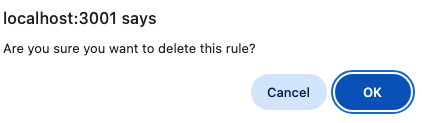
Step 2: Confirm Deletion
- Review the warning message
- See which devices will be affected
- Optionally, enter the restriction name for additional confirmation
- Click on OK
- Restriction is permanently removed
After Deletion
- Restriction is removed from the server
- On next sync, devices remove the restriction from local storage
- Previously blocked software is no longer blocked by this restriction
Alternative to Deletion
Instead of deleting, consider:
- Deactivating: Temporarily suspend without removing
- Documenting: Add notes about why it's no longer needed before deleting
Testing Restrictions
Before activating a restriction, test it to ensure it works as expected.
Test Rule Evaluation
GetApp supports live rule evaluation directly from the rule builder. You can test your restriction rule against all registered devices before saving or activating it.
See Evaluating Rules for a full walkthrough.
Test on Non-Production Devices
- Create the restriction but keep it Inactive
- Review the rule logic carefully
- Associate with a test device first
- Activate the restriction
- Attempt to install software on the test device
- Verify expected blocking behavior
- Check agent logs for restriction evaluation
- Deactivate if issues are found
- Fix and re-test
- Expand associations once validated
Monitor Agent Logs
After activating a restriction:
- Check agent logs on affected devices
- Look for restriction evaluation messages
- Verify expected installations are blocked
- Watch for unexpected blockages
- Review any evaluation errors
Gradual Rollout
For critical restrictions:
- Start with a small group of test devices
- Monitor for a period (hours or days)
- Gradually expand to more devices
- Expand to device types only when confident
- Monitor continuously
Viewing Restriction History
Restriction version history helps track changes over time.
Version Number
Each restriction displays its current version number. The version increments when:
- The rule expression is modified
- The associations change
Sync History
Some systems track sync history:
- When the restriction was synced to each device
- Success or failure status
- Version synced to each device
Monitoring Restriction Effectiveness
Blocked Installation Count
Track how many installations each restriction has blocked:
- View restriction details
- Check Blocked Count or Evaluations section
- See which devices were affected
Affected Devices List
See which devices currently have the restriction:
- Open restriction details
- View Affected Devices tab
- See list of devices, their types, and sync status
Restriction Impact Report
Generate reports on restriction effectiveness:
- Number of blocks per restriction
- Most frequently blocked software
- Devices most affected by restrictions
Restriction Management Best Practices
Naming Conventions
Use clear, descriptive naming:
- Good: "Block-Dev-Software-Production", "Prevent-Old-SSL-Library"
- Avoid: "Restriction1", "test", "temp"
Documentation
Always add descriptions:
- Explain what is blocked and why
- Document the business reason or compliance requirement
- Note any dependencies or related restrictions
- Include contact information for questions
Start Inactive and Narrow
When creating new restrictions:
- Create with Inactive status
- Associate with a test device first
- Test thoroughly
- Activate for test device
- Expand associations gradually
- Monitor continuously
Regular Reviews
Periodically review your restrictions:
- Remove obsolete restrictions
- Update outdated criteria
- Consolidate overlapping restrictions
- Document changes
- Verify restrictions still serve their purpose
Testing Workflow
- Create restriction (inactive)
- Associate with test device
- Review rule logic
- Activate for test device
- Test blocking behavior
- Monitor agent logs
- Expand to device type or OS type
- Monitor production impact
- Continue monitoring
Monitor Device Logs
Regularly check agent logs:
- Look for unexpected blockages
- Verify restrictions are working as intended
- Identify any evaluation errors
- Understand user impact
Troubleshooting
Restriction Not Blocking
Problem: Created restriction but software still installs.
Solutions:
- Verify restriction is Active
- Check device is in the associations (device ID, type, or OS)
- Verify rule logic matches the software being installed
- Ensure device has synced recently
- Check agent logs for restriction evaluation
- Verify agent version supports restrictions
- Test rule evaluation manually
- Check for conflicting or overriding configurations
Installation Blocked Unexpectedly
Problem: Software is blocked but shouldn't be.
Solutions:
- Check which restriction is blocking (agent logs show this)
- Review the restriction's rule logic
- Verify the software properties match the rule
- Check if multiple restrictions apply
- Deactivate the restriction temporarily if needed
- Modify the rule to be more specific
- Test the updated rule
Restriction Not Syncing
Problem: Restriction not appearing on devices.
Solutions:
- Verify restriction is Active
- Check device association is correct
- Ensure device is online and connected
- Trigger manual sync from device or Dashboard
- Check network connectivity
- Review server logs for sync errors
- Verify agent is running and up-to-date
- Check agent sync interval settings
Performance Issues
Problem: Agent is slow due to restriction evaluation.
Solutions:
- Simplify restriction rules
- Reduce number of restrictions per device
- Remove obsolete restrictions
- Optimize rule expressions
- Check device resources (CPU, memory)
- Review agent logs for evaluation errors
Can't Create Restriction
Problem: Create button doesn't work or error when saving.
Solutions:
- Check user permissions
- Verify all required fields are filled
- Check rule syntax is valid
- Ensure at least one association is selected
- Try a different browser if UI issues persist
- Check for conflicting browser extensions
Next Steps
- Learn about Managing Policies
- Understand Rule Fields and Expressions